Rethinking the Small Room Acoustics Dilemma
Small rooms are often treated as acoustic problems to be covered rather than understood. The familiar response is to attach foam to every available surface until reflections disappear. The result may look like a studio, but it can sound worse: unnaturally dull, tonally unbalanced, and strangely fatiguing. Thin foam can reduce some high-frequency reflections while leaving the most disruptive low-frequency resonances almost untouched. A room that has lost its useful acoustic life is not automatically an accurate room.
The first distinction is between soundproofing and acoustic treatment. Soundproofing attempts to reduce sound transmission through walls, ceilings, doors, and floors. That requires mass, airtight construction, decoupling, and structural planning. Acoustic treatment works inside the room. It controls reflections, modal decay, resonance, and stereo imaging so that the sound reaching the listener is more trustworthy. The objective is not silence. It is controlled acoustic energy, with enough liveliness to preserve musical scale and enough restraint to prevent the room from rewriting the mix.
Understanding Room Modes and Standing Waves in Confined Spaces
Room modes are resonances created when sound reflects between boundaries. At certain frequencies, the distance between walls, floor, or ceiling supports repeated reinforcement. The reflected wave returns in phase with the outgoing wave, producing a standing pattern of pressure peaks and nulls. A listener may hear a bass note as exaggerated in one position and nearly absent only a short distance away. These changes are not caused by the loudspeaker alone. They are consequences of the room”s dimensions and the listener”s location.
Rectangular rooms contain axial modes involving two opposing surfaces, tangential modes involving four surfaces, and oblique modes involving all six. Each mode has higher-order variations as additional wavelengths fit between boundaries. This is why small rooms can sound uneven even when their dimensions appear reasonable. There is no perfect room ratio that eliminates every mode, and changing the shape does not abolish resonance. It merely redistributes where resonances occur. The practical goal is to reduce excessive buildup and shorten modal decay, not to chase complete cancellation.
The most aggressive pressure zones occur at boundaries, particularly where multiple surfaces meet. This is the physical reason the room corners deserve attention before decorative wall panels. Useful diagnosis can include measurements from several listening positions, a sine sweep, or carefully controlled pink-noise tests. A measurement does not replace listening, but it helps distinguish a persistent modal problem from a speaker-placement issue or a narrow listening-position null. For a concise explanation of how standing waves alter bass response in compact studios, the key principle is simple: frequency response and decay are related, but they are not identical problems.
- Axial modes are usually the strongest and easiest to identify.
- Nulls can be caused by cancellation and may not be fixed by adding absorption at the listening position.
- Modal ringing can remain audible after the initial bass transient has stopped.
- Speaker and seat placement should be adjusted before treatment is used to compensate for avoidable geometry.
Targeting the Low End with Strategic Corner Bass Traps
Porous absorbers work by converting air motion into heat through friction. Their efficiency depends on the movement of air through the material, which means placement matters. At a rigid wall, particle velocity is low while acoustic pressure is high. A porous panel placed directly against that wall may still be useful in the midrange, but it is not taking full advantage of the absorber”s velocity-based mechanism at low frequencies. Thickness and distance from the boundary become increasingly important as wavelength increases.
Corner treatment is therefore a high-impact starting point. Wall-wall-floor and wall-wall-ceiling intersections combine boundary pressure zones, while floor-to-ceiling treatment in the four vertical wall corners addresses a broad range of modal behavior. If space or budget is limited, prioritize the front corners symmetrically, then expand treatment rather than placing isolated panels randomly. Large broadband traps with substantial depth generally provide more useful low-frequency control than thin decorative products.
An air gap behind a panel can improve performance because the absorber interacts with air motion farther from the rigid boundary. The quarter-wavelength idea is a useful guide, not an absolute installation law. A gap of several inches can improve lower-frequency absorption, but it does not transform a thin panel into a true subwoofer trap. Extremely low frequencies may require thicker porous structures or purpose-built membrane and diaphragmatic absorbers. The best installation balances acoustic benefit with access, ventilation, fire safety, and the room”s everyday function.
- Begin with the four vertical wall corners where possible.
- Use deep broadband material rather than relying only on thin foam.
- Leave an air gap when the construction allows it and the panel remains secure.
- Measure decay and frequency response after each major change.
Material Comparison for Effective Acoustic Absorption
Material choice affects more than appearance. Open-cell polyurethane foam is lightweight, affordable, and convenient for treating selected high-frequency reflections. Its limitations become clear in the low-mid and bass ranges, where meaningful absorption requires considerable thickness. Dense rockwool and rigid fiberglass generally offer better broadband performance when built into thick panels or corner traps. They can control lower frequencies more effectively, although their performance depends on density, thickness, mounting distance, and the specific product.
Panels should be wrapped in acoustically transparent fabric and constructed so that fibers cannot escape into the room. Rockwool is naturally non-combustible in many product grades, while fiberglass boards offer a rigid, efficient format that can be easier to frame. Always check the manufacturer”s fire classification and handling guidance rather than assuming that every product in a material category behaves identically. A practical comparison of high-density mineral wool cores to standard polyurethane options reinforces the main point: thickness and construction are as important as the name printed on the package.
| Material | Strengths | Limitations | Best use |
|---|---|---|---|
| Open-cell acoustic foam | Lightweight, inexpensive, easy to shape | Limited low-frequency control, variable durability | Selective high-frequency reflection control |
| Rockwool | Broadband potential, non-combustible product grades, suitable for deep traps | Requires careful wrapping and installation | Corner traps and thick broadband panels |
| Rigid fiberglass | Efficient for its thickness, rigid, easy to frame | Higher cost and protective handling requirements | First-reflection panels and broadband absorbers |
Pinpointing First Reflections Using the Mirror Method
First reflections are the early arrivals that bounce from side walls, the ceiling, or nearby surfaces before reaching the listener. When they arrive close enough to the direct sound, they can blur stereo localization, weaken phantom-center stability, and create comb filtering through phase interaction. The effect is often subtle at first: vocals feel less anchored, panning decisions become uncertain, and midrange detail seems to change when the listener moves slightly.
The mirror method provides a practical way to locate side-wall reflection zones. It identifies the point where a listener can see a loudspeaker”s relevant radiating area from the listening position through a mirror placed against the wall. The goal is not to decide whether only the tweeter, cone, or cabinet must appear. The reflection path depends on the speaker”s dispersion and the frequencies being considered. Treating a sufficiently broad area around the visible speaker position is more reliable than targeting a tiny visual point.
- Place the listening chair and speakers in their intended working positions, with left-right symmetry as close as possible.
- Ask a listening partner to move a small mirror along the side wall at seated ear height.
- Mark the position where the speaker becomes visible from the listening seat, then repeat the process on the opposite wall.
- Mount thick, broadband panels over the marked zones, extending beyond the narrow point when practical.
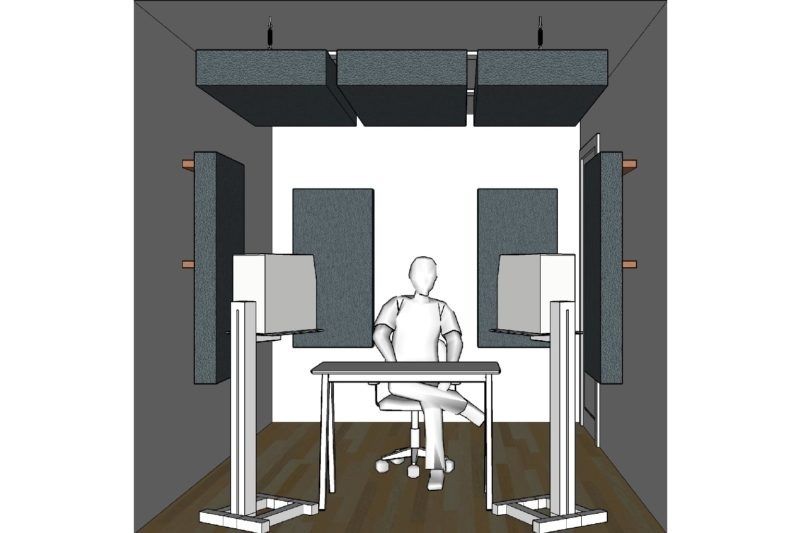
- Repeat the process on the ceiling to locate the vertical reflection path and install a cloud directly above the mixing position.
Panel placement should preserve symmetry. If the left wall receives a large absorber at the first reflection point, the right wall should receive an equivalent treatment whenever possible. The ceiling cloud deserves particular attention because vertical reflections can combine with desk reflections and create a dense cluster of early energy. A cloud should hang securely, with a meaningful air space above it, while maintaining safe clearance from lighting, ventilation, and the listener.
Balancing Absorption and Diffusion for a Natural Soundfield
Absorption removes acoustic energy by converting it into heat. Diffusion does something different: it scatters reflected energy across time and direction without eliminating it. This distinction matters in a small room. Absorption is highly effective at reducing strong first reflections, flutter echo, and excessive reverberation. Diffusion can preserve spaciousness while preventing a hard, focused reflection from returning directly to the listener.
Pure absorption can create an unnerving environment. The room becomes quiet but not necessarily accurate, with a short, uneven reverberation profile and a sense that high frequencies have vanished while low-frequency problems remain. Long sessions in such a space can be fatiguing because the listener loses natural acoustic cues. A balanced room usually combines bass control, targeted broadband absorption, and carefully selected scattering surfaces. As acoustic treatment guidance makes clear, diffusion is not a substitute for absorption, and absorption is not a universal solution.
In smaller rooms, diffusion belongs where sufficient distance exists for scattered reflections to develop before reaching the listening chair. The rear wall is often a candidate, provided the diffuser has suitable depth and the room is not so short that its wells or facets create strong nearby coloration. A bookshelf can provide irregular scattering, but it is not a calibrated diffuser. Use it as a helpful secondary feature, not as a replacement for measured treatment. Keep the front of the room controlled and maintain symmetry around the listening axis, then introduce diffusion where it adds depth without producing a new cluster of early reflections.
- Absorb first reflections that compromise imaging.
- Use bass traps to manage buildup and decay rather than expecting thin panels to fix deep nulls.
- Reserve diffusion for surfaces with adequate listening distance.
- Retain some controlled liveliness so music remains spacious and engaging.
Building an Accurate and Inspiring Sound Environment
Small-room optimization is an iterative process, not an overnight installation. Begin with speaker placement, listening position, and left-right symmetry. Establish a baseline with familiar recordings and simple measurements, then address the highest-impact problems in order: dominant low-frequency buildup, first reflections, ceiling reflections, and the rear-wall response. Each change should be evaluated from the working seat and from a few nearby positions, because a treatment that improves one location can expose a different problem elsewhere.
The most successful room is not the room with the most panels. It is the room that lets decisions translate reliably while still feeling like a place where music belongs. Deep corner traps, properly mounted broadband absorbers, a well-positioned ceiling cloud, and restrained use of diffusion can deliver dramatic gains without turning a domestic interior into an industrial box. Good acoustics respect both physics and daily life: clarity for the engineer, comfort for the listener, and enough natural energy for the room to remain inspiring.